Neuroscientist Dr Katharine Campbell has written an award-winning biography of her father Sholto (Marshal of the Royal Air Force Lord Douglas of Kirtleside), Behold the Dark Gray Man.
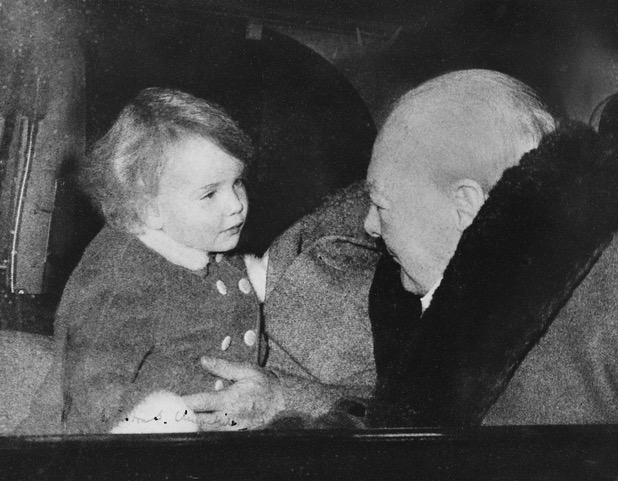
My purpose began to reveal itself when I was five years old following my father Sholto’s first stroke at the end of 1962. He was 63 when I was born in 1957 so he had fought in both World Wars, in WWI as an officer first in the Royal Horse Artillery and then in the Royal Flying Corps (RFC), from April 1918 the Royal Air Force (RAF). He was in high command in the RAF throughout WWII and finished his military career as Military Governor of the British Zone in postwar Germany. At the time of my birth he was Chairman of British European Airways, a post he held for fifteen years. His extraordinary story is told in my biography of him, Behold the Dark Gray Man, published by Biteback in 2021.

In the years following his first stroke, Sholto became increasingly incapacitated by more strokes. The incipient post-traumatic stress disorder (PTSD) that had stalked him since his troubled childhood revealed itself in florid symptoms such as nocturnal somnambulisms, when he relived his experiences of sentencing in postwar Germany. However, at the time he was characterised as a demented old man and it wasn’t until decades later, following my second career as a neuroscientist, that I realised the true cause of his nighttime wanderings and daytime distress.
By the time I was eight years old I had decided to become a nurse, because I did not want to see anyone suffer both physically and psychologically as much as Sholto did, especially someone I loved so much, and not be able to help them. I kept this in mind all through my school years and my first degree was in nursing at Manchester University. Part way through my time there, I could see that midwives had greater autonomy and I did not want to be a ‘doctor’s handmaiden,’ so following my degree, I trained and practised as a midwife. A few years later, as the newborn intensive care unit at the hospital where I had been a midwife was understaffed, I was asked to work there. At first, I was reluctant to do so, but I quickly became absorbed in caring for tiny, vulnerable preterm babies. So often when I opened incubator doors to give care, I sensed the little ones recoiling as though even touch was painful. I became preoccupied with how newborns might experience pain and this was a burgeoning research topic at the time. Two kind doctors urged me to do a research degree, so I applied to do a Master of Science (MSc) degree in biomedical sciences at King’s College London, with a focus on neurobiology, the field under which pain research comes. The course organiser was kind enough to arrange an intercollegiate MSc for me because she realised that there was only one person with whom I could do my project, Professor Maria Fitzgerald at University College London. She was and is at the forefront of developmental pain research. This led to a PhD in neuroscience there with Maria as my supervisor.
However, in the middle of my doctorate, disaster struck. Following an operation, I developed lupus, which was life-threatening when it first appeared. This was a severe blow to my sense of purpose. Nevertheless, I continued writing the introduction to my PhD thesis on my hospital bed and after fourteen months off sick, I completed my PhD and worked for another seven years with Maria as a postdoctoral fellow on pain mechanisms in newborns and infants under one year.
I loved my job, but my illness had not gone away, and since I had met my second husband Peter and moved to Hampshire, I realised that I could not handle the commute to London and cope with my health issues at the same time, so I had to regroup yet again and rediscover my purpose. After some years, I found it by writing Sholto’s biography. He had been the subject of some controversies during his career in WWII, and I wondered whether certain historians’ unflattering assessment of him was warranted. So I wanted to address what I suspected were misconceptions and also to reacquaint myself with the father who had died when I was twelve years old.
Furthermore, I wished to get to the bottom of what I felt was the root cause of his suffering. I had been taught research methods very well during my postgraduate degrees, and so started an extensive literature search, beginning with the question ‘what was the pain’ in Sholto’s life? Quite soon I realised that the characterisation of him in my childhood by medical and other healthcare staff as an old man suffering from dementia was by no means the whole story and I read extensively the scientific literature concerning PTSD. I also consulted leading experts in this field in the Netherlands and Australia and will be forever grateful for their help and insights. As a result, Behold the Dark Gray Man is not only an account of Sholto’s life but also contains an analysis of PTSD as it affected him. At each stage of his life, I look at what treatment or lack thereof was available at the time, and the final chapter is a detailed review of the scientific literature concerning the causes and symptoms of the features of PTSD that Sholto manifested.
Throughout my book journey of eight and a half years from beginning the research to publication, my lovely husband Peter was with me at every step. He was my strongest supporter and advocate. We journeyed around Europe, visiting an archive in the Netherlands, historians and sites in Germany associated with Sholto’s time as Military Governor there, as well as Warsaw to look in secretive archives.

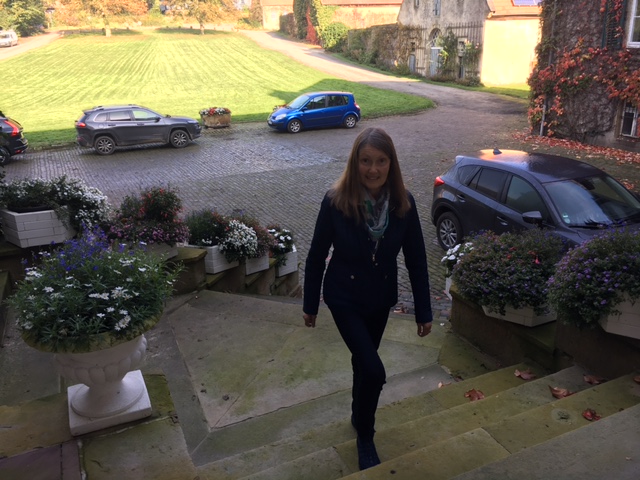
We also found Sholto’s WWI airfields and went to war graves in northern France, including to Ration Farm Military Cemetery where Sholto’s youngest brother, my Uncle Archie, is buried. He was an observer in the RFC and he and his pilot were shot down in 1916.
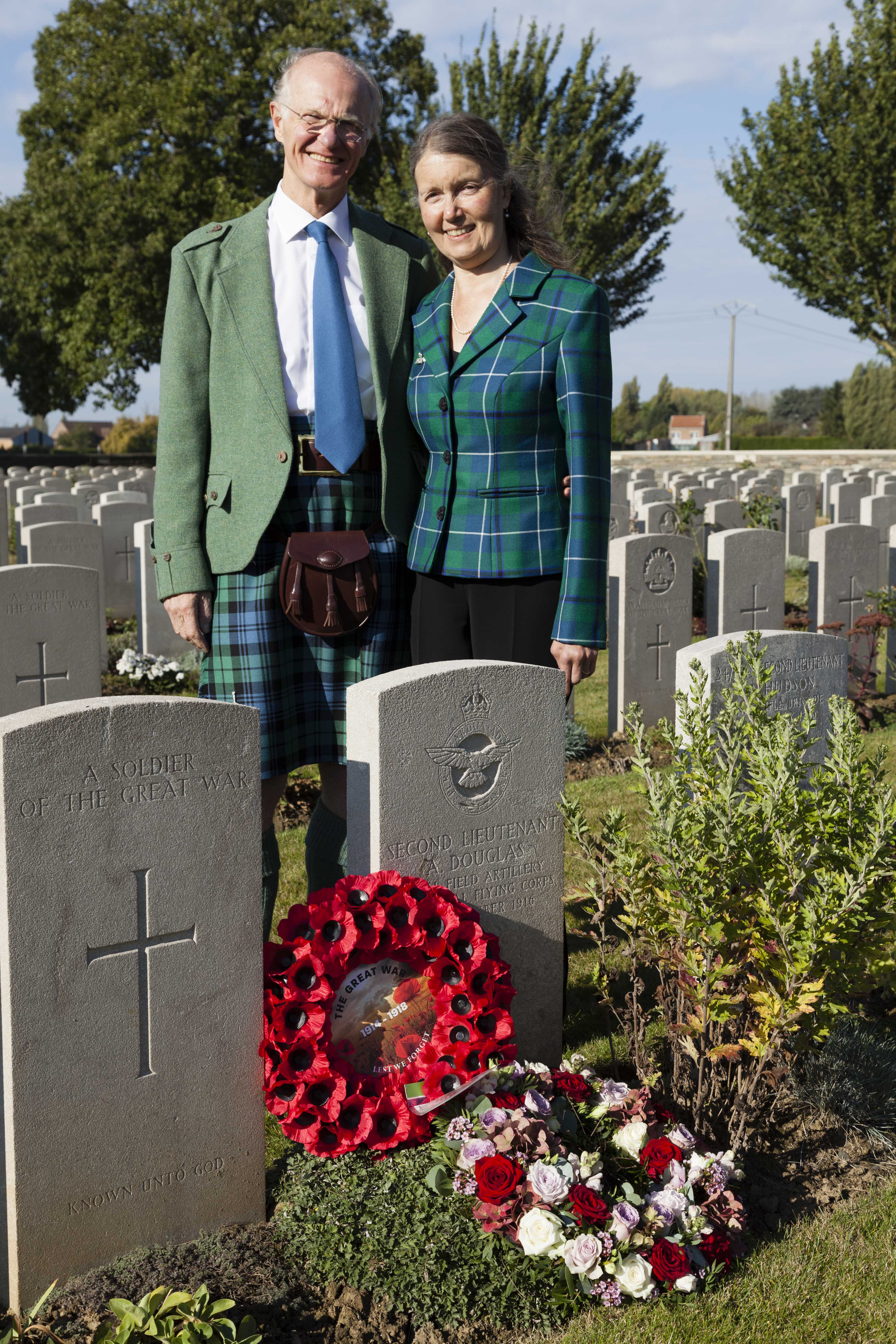
Peter entered enthusiastically into the exploration, my purpose becoming his preoccupation also. He had served eleven years in the British Army, the last four as a helicopter pilot, before entering the world of commercial aviation, so was invaluable in familiarising me further with the jargon and way of life in the Armed Forces, not to mention his extensive experience as an aviator and aviation consultant.
My book research and writing led to other occasions that strengthened and reinforced my sense of purpose, including involvement with the RAF. I was invited to participate in its Centenary Service in 2018 in Westminster Abbey, at which I began the prayers and was interviewed by Babita Sharma of BBC World Service.

My book was selected for the Chief of the Air Staff’s Reading List in 2022 and I was invited to write an article on Sholto’s role in the development and application of radar, which was published in the Spring 2023 volume of the RAF Air and Space Power Review, devoted entirely to contributions written by women.
Since the book was published in 2021, I have written papers for peer-reviewed journals on scientific and historical subjects, including a paper on the neurobiology of childhood trauma that links my work on developmental pain mechanisms with that on PTSD. It has had over ten thousand views.In all of these endeavours, Peter was my constant companion and support. During the pandemic, we isolated ourselves but relished each other’s company and grew even closer if that was possible.
All of that changed one evening sixteen months ago when suddenly and without warning, Peter developed the most terrible pain. It was horrifying to watch him in such agony and he said, ‘I am not sure I am going to live through this’. I called 999 and the ambulance arrived very quickly, taking him and me to hospital. A scan revealed that he had a double twist of the small bowel and although he had an operation to remedy this in the middle of the night, his life could not be saved and he died the following afternoon. He went from being an apparently healthy man, enthusiastically rushing about in our garden and coming in to eat supper, to dying, in nineteen and a half hours. Of course, it was by far the most traumatic episode of his life, but also of mine, and I have been utterly devastated by his death. For the second time in my life, I have not been able to rescue the person whom I love most in the world.
All of us are likely to have suffered traumatic events in our lives, blowing whatever sense of purpose we might have to small pieces. How does one come back from that? I am still trying to find out. For some people who have suffered appalling life events such as these, their purpose thereafter is defined by the catastrophe itself. The Hillsborough disaster and the Post Office scandal are two such instances, in which victims and their families have found their sense of purpose in the search for justice.
For me, I have gone back to my initial motivation of the relief of suffering, which has actually been there all along. I cannot bear to see people enduring physical or psychological pain and not be able to help in some way. It is no longer possible for me to be on the front line in the NHS or in clinical experimental science, but what I want to do in my writing is to highlight the extremes of human experience and to endeavour to promote ways of understanding and alleviating suffering as far as possible.
Behold the Dark Gray Man: Triumphs and Trauma, the Controversial Life of Sholto Douglas, Biteback Publishing, July 2021
https://www.bitebackpublishing.com/books/behold-the-dark-gray-man

